| January 2006 Index | Home Page |
Editor’s Note: This is not a recent study, but it fits well with the context of expanding eLearning to new populations of learners as the technology becomes available. It provides a time dimension to remind us that adoption with confidence or comfort is not an instant process for individuals without prior experience and that comfort in using technology takes longer those who learn at a distance. This study is limited to browsers, but each successive technology, such as messaging and blogging, has its own take-off, development and saturation (s-curve) as described by Derek J. de Solla Price (1963). Little Science, Big Science.
A Longitudinal Study of the Uptake of
and Confidence in using WWW Browsers
among Parks Management Students
Dirk H.R. Spennemann
Abstract
The 1990’s saw an unprecedented growth of the WWW. It was assumed that students would correspondingly take up the associated technologies. Between 1995 and 2000 a longitudinal study was carried out to test the usage and confidence of students using WWW browsers in a university environment. The results show that use of the WWW has increased to near saturation levels although a bias is evident between male and female users. A correlation was established between the frequency of use and confidence with which WWW browsers are being used.
Keywords: confidence, WWW, students, longitudinal
Introduction
In the mid 1990s a brave new world of telecommunications in the form of the information superhighway beckoned. It was touted as offering great promise of becoming the great leveller, allowing anybody with access to a server, to gain access to a huge amount of data well beyond that currently available in their local geographical area. Brick and mortar infrastructure would no longer be a barrier to this exciting information age that was available to those who had access to the Internet and more particularly to the World Wide Web (WWW). Information technology has effectively changed the mode of delivery of many of the traditional paper based resources to those now being delivered electronically. It also has brought about an increasing reliance on the use of such technology both as a tool to access communication resources but also as the means to facilitate learning and teaching Australia (cf. Atkinson et al 1997; Spennemann 1999). The technology associated with the WWW has opened up new options in areas from electronic commerce to online education. For example, information technology has now become an integral medium for the delivery of teaching and learning resources in tertiary institutions throughout Australia (cf. Atkinson et al 1997). This increased reliance on technology has meant that people wishing to access information resources need to be competent and confident users of the available technology. The industry and many ‘hawkish’ proponents assert that this is a given and it should be of no concern. Yet such concerns have been raised for rural areas (Valentine and Holloway 2001) and for poor developing countries (Spennemann et al 1996).
It has been claimed that information technology has a significant impact on education and it technology is an area that students can not afford to ignorant about (Schott and Selwyn 2000). However not all students utilise new technologies in the same way with factors such as gender (Brosnan 1998; Clegg 2001) and the personal learning styles of the users affecting how they are used (Shuell and Faber 2001). Other barriers that might affect the adoption of information technology in an education environment include the lecturer’s attitude or perception about a technology, the student’s competency level with the technology, the availability and accessibility of the hardware and the software (Atkinson and Spennemann in press; Honey et al. 2000; Spennemann and Atkinson 2002a, 2002b, in press), the presence of technical personnel and institutional support, and a program for staff development and skill building (Rogers 2000)
From an educational stand point, much of the literature deals with students’ learning based on computer aided technologies (cf Spennemann 1998, 1999). Other studies have looked at the attitudes and skill levels of high school students (Meredyth et al 1999, 2000) and first year students (Lim and Kendle 2001, Lim and Lee 2000, Flowers et al 2000, Palmer and Bray 2001, Spennemann 1996).
The authors carried out a longitudinal study into computer use and confidence among Environmental Science Students at an Australian Institution from 1995 to 2000 (Spennemann & Atkinson 2002a). Some aspects such as data management behaviour (Spennemann and Atkinson 2002b), e-mail usage (Spennemann and Atkinson 2002b) and aspects of gender on computing (Atkinson and Spennemann in press) have been reported elsewhere. In this paper we will report on a longitudinal study into the use of the World Wide Web software applications among park management students. The findings from the 2000 study will also be compared to a cohort of students studying information technology.
The Study
A study was conceptualised in 1995 as a quality assurance exercise for the subject PKM 266 Cultural Resource Management, at Charles Sturt University (Albury, New South Wales, Australia). The aim of this study was to assess the computer access, abilities and confidence level of the student population when using the World Wide Web. This exercise developed into a longitudinal study sampling both the entire internal and the entire external student population enrolled in the subject during the period 1995 to 2000. The survey instrument was an anonymous, compulsory questionnaire handed out at first lecture (2nd semester, 1st year). It relied on self-reporting and self-evaluation by the student and elicited the required information through multiple options and attitudinal responses using a 6- and 9-point Likert scale. Because of the quality assurance character of the study the return rate of the questionnaire was 100% of the students attending class.
The survey was administered in 1995, 1996, 1997, 1998 and 2000 to the internal student population and in 1995, 1997 and 2000 to the distance education students. No data were collected for 1999 when the principal author (Spennemann) was on sabbatical and the subject PKM 266 was taught by a relief lecturer.
The cohorts analysed during the respective studies were drawn from students undertaking the Parks Management and Ecotourism degrees taught in the Faculty of Science and Agriculture. From 2000 students in Information Technology were also included in this research. Anecdotal evidence and long-term teaching experience by staff suggest that the bulk of the Parks Management students were apathetic towards computer technology and that many express dislike and even anxiety. In this regard, this cohort of students appeared to be a representative sample of students in ‘real world’.
The parks management student population falls into two parts, those students studying in face-to-face mode at Albury campus, and those students studying in distance education mode from their home location. These locations vary widely and range from capital cities (such as Sydney, Brisbane or Melbourne) to parks rangers working in remote national parks with limited communications access, including delayed mail delivery and unreliable telecommunications. This has always posed a special challenge and the new rollout of technology has not always alleviated this (Spennemann 1995).
The internal students are, on average, straight school leavers (62% aged 18-19 in 2000), while the external students are on average in their early to mid-thirties, are in full-time or part-time paid work, often in related fields or actually as a ranger in one of the parks management services.
With the exception of 1999, the male to female student ratio is close to 1:1 among the internal student population of the core subject PKM 266. The gender balance was originally more skewed towards the males among the external population.
Given the fact that CSU is a regional university, it was of interest to ascertain whether the attitudes towards the use of the World Wide Web might vary depending upon their previous geographical location. About half the student population (both internal and external) came from rural areas, followed by students from non-capital cities and metropolitan students. Among the external student population the percentage of students from rural backgrounds is on the increase.
WWW browser use
A WWW browser is a software application that allows users to interface with the World Wide Web (WWW). The WWW was commercially introduced in 1993 and since that time its usage and growth has been exponential (Haynal 2000). The two most common WWW browsers available today are MS Explorer and Netscape. A WWW browser is simple and intuitive to learn and it is the tool that enables users to access large amounts of on-line hypertext information.
Unlike other applications, such as word processors, spreadsheets and databases, WWW browsers are a recent development and one that is inextricably linked to the development of the internet/WWW as a communications and information provision tool. Thus it can be posited that as the information content increases, as measured in the number of websites and the number of pages, this could and should result in an increase in its use. In short, while standard applications, such as word processors, have a confined market, the WWW continues to be a rapidly expanding resource. The increased popularity of the WWW should be reflected in the use of the WWW browser both in absolute terms and relative to other applications.
For the first part of this research the cohorts were asked to indicate their usage and confidence in the use of the WWW. In particular, participants were asked to self-assess the frequency of use of WWW browsers. Respondents were asked to select one of the following answers with regard to their usage of a WWW browser: ‘never/not yet,’ ‘seldom,’ ‘once in a while,’ ‘often,’ ‘regularly’ and 'daily.'
The popularity of a WWW browser is reflected by the dramatic increase in its usage by the students in this survey (table 1). For example, while in 1995 46% of all internal students had never used a WWW browser this number had decreased to less than 5% by 2000. Similarly, whereas fewer than 2% of students used a WWW browser on a regular or daily basis in 1995, this had increased to 50% by 2000.
Table 1
Usage of World Wide Web Browsers
| Internal Parks | External Parks | IT | ||||||
| 1995 | 1996 | 1997 | 1998 | 2000 | 1995 | 1997 | 2000 | 2000 |
Never | 46.43 | 22.60 | 16.00 | 14.52 | 3.77 | 46.03 | 32.35 | 4.76 | 3.03 |
Seldom | 3.57 | 15.07 | 18.00 | 17.74 | 1.89 | 4.76 | 14.71 | 2.38 | 3.03 |
once in a while | 10.71 | 20.55 | 21.00 | 24.19 | 16.98 | 4.76 | 13.24 | 23.81 | — |
Often | — | 10.96 | 8.00 | 22.58 | 18.87 | — | 8.82 | 9.52 | 3.03 |
Regularly | — | 7.53 | 12.00 | 11.29 | 39.62 | 1.59 | 4.41 | 23.81 | 12.12 |
Daily | — | 1.37 | 3.00 | 4.84 | 9.43 | — | 4.41 | 26.19 | 78.79 |
no answer | 39.29 | 21.92 | 22.00 | 4.84 | 9.43 | 42.86 | 22.06 | 9.52 | — |
N | 56 | 146 | 98 | 62 | 53 | 62 | 66 | 41 | 33 |
Figure 1 shows the significant uptake in the usage of World-wide web browsers since 1995. Interesting, this figure also illustrates a levelling out in the use of the WWW since 1997 although the overall usage level of the WWW still remains extremely high.
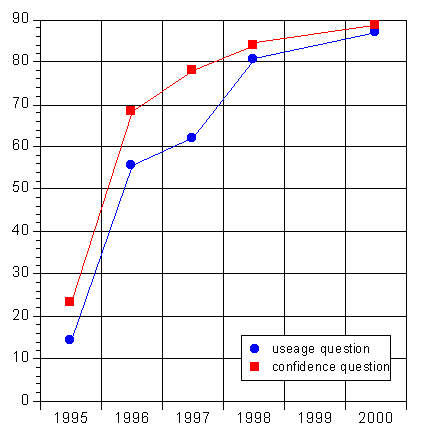
Figure 1. Uptake of World Wide Web Browser programs over time
as expressed by internal students providing a positive answer.
Table 2
Internal Student's Usage of World Wide Web Browsers.
Breakdown by Gender
| 1995 | 1996 | 1997 | 1998 | 2000 | |||||
| Fem | Male | Fem | Male | Fem | Male | Fem | Male | Fem | Male |
Never | 59.26 | 34.48 | 29.41 | 17.11 | 13.21 | 20.00 | 17.65 | 10.71 | — | 8.33 |
Seldom | — | 6.90 | 14.71 | 15.79 | 20.75 | 15.56 | 20.59 | 14.29 | 3.45 | — |
once in a while | 11.11 | 10.34 | 19.12 | 22.37 | 20.75 | 20.00 | 20.59 | 28.57 | 17.24 | 16.67 |
Often | — | — | 8.82 | 13.16 | 11.32 | 4.44 | 20.59 | 25.00 | 24.14 | 12.50 |
Regularly | — | — | 7.35 | 7.89 | 13.21 | 11.11 | 17.65 | 3.57 | 37.93 | 41.67 |
Daily | — | — | 2.94 | — | — | 4.44 | — | 10.71 | 6.90 | 12.50 |
no answer | 29.63 | 48.28 | 17.65 | 23.68 | 20.75 | 24.44 | 2.94 | 7.14 | 10.34 | 8.33 |
N | 27 | 29 | 68 | 76 | 52 | 44 | 34 | 28 | 29 | 24 |
In terms of gender it is not possible to differentiate any trends in the usage of WWW browsers by the internal student population (table 2). On the whole, male students claim to be slightly more regular users—but this may well be the result of a male confidence bias inherent in the self-reporting method used in the survey. Among the external students (table 3), women tended to be less frequent users in the past, but this trend appears to have reversed in 2000. This result contradicts the more general finding of Mitra et al (2000) that men ‘tended to use computers more than women’.
An assessment of the upbringing of the student (metropolitan, non-metropolitan city, rural) showed differences in all samples, but did not reveal any diachronic patterns.
Table 3
External Student's Usage of World Wide Web Browsers.
Breakdown by Gender
| 1995 | 1997 | 2000 | |||
| Fem | Male | Fem | Male | Fem | Male |
Never | 58.82 | 40.00 | 35.29 | 31.25 | 4.17 | 5.88 |
Seldom | 5.88 | 4.44 | 17.65 | 12.50 | — | 5.88 |
once in a while | — | 6.67 | 23.53 | — | 20.83 | 23.53 |
Often | — | — | 14.71 | 3.13 | 8.33 | 11.76 |
Regularly | — | 2.22 | 2.94 | 6.25 | 25.00 | 23.53 |
Daily | — | — | — | 9.38 | 29.17 | 23.53 |
no answer | 35.29 | 46.67 | 5.88 | 37.5 | 12.50 | 5.88 |
N | 17 | 44 | 33 | 31 | 23 | 17 |
A comparison of the usage of WWW browsers between IT and Parks students in 2000 illustrates a significant difference between the two cohorts (table 1). IT students are more regular users of the WWW with nearly 80% of students using it on a daily basis compared to less than 10% with external Parks students. This result is not surprising as IT students at CSU are required to access a majority of their course resources using a WWW browser. Even though it is expected that this differentiation between Parks and IT students will continue in the future; extrapolation of the expected usage by Parks students suggest that this gap will decrease over the next few years.
Confidence
The level of computer use is one measure of technological change and acceptance. However the extent of computer use does not fully reflect a student's ability to deal with the technology and the associated applications. An alternate approach is to investigate respondents' confidence when using such applications.
To measure their level of confidence, respondents’ were asked to self rate themselves as to the type of user of computer technology they are. Respondents were given the option to select one of the following nine answer options: ‘power user,’ ‘very confident,’ ‘confident,’ ‘comfortable,’ ‘uncomfortable,’ ‘a bit daunted,’ ‘very uneasy,’ ‘near panic,’ and ‘not yet used.’ This approach might create a bias in the gender-specific responses, as males may be more assertive and positive in their responses than women; however the approach detailed is believed to be a good surrogate measure of their actual state of anxiety/confidence.
Statistical analysis (t-test) was carried out to compare between each of the annual averages for the internal and external populations respectively, as well as for the averages for 1995, 1997 and 2000 comparing the internal with the external populations. The average response (coded as 0 for ‘not yet used’ and 8 for ‘power user’) was calculated for each and plotted with their standard deviations as graphs to show the diachronic development of computer confidence.
Table 4
Confidence when using World Wide Web Browsers
| Internal Parks | External Parks | IT | ||||||
| 1995 | 1996 | 1997 | 1998 | 2000 | 1995 | 1997 | 2000 | 2000 |
Not yet | 39.29 | 17.12 | 11.00 | 9.68 | 3.77 | 47.62 | 25.00 | 2.38 | — |
Near panic | — | 2.74 | 1.00 | — | — | 1.59 | 1.47 | — | — |
Very Uneasy | 1.79 | 1.37 | 2.00 | 4.84 | 3.77 | 1.59 | 4.41 | — | — |
A bit daunted | 8.93 | 11.64 | 13.00 | 11.29 | 1.89 | 3.17 | 13.24 | 4.76 | — |
Uncomfortable | 8.93 | 7.53 | 9.00 | 8.06 | 7.55 | 1.59 | 7.35 | 2.38 | — |
Comfortable | 3.57 | 25.34 | 27.00 | 27.42 | 11.32 | 4.76 | 10.29 | 26.19 | — |
Confident | — | 11.64 | 16.00 | 24.19 | 28.3 | 3.17 | 4.41 | 19.05 | 9.09 |
Very confident | — | 6.85 | 7.00 | 8.06 | 26.42 | — | 8.82 | 35.71 | 21.21 |
Power User | — | 1.37 | 3.00 | — | 9.43 | — | 1.47 | 2.38 | 69.70 |
no answer | 37.50 | 14.38 | 11.00 | 6.45 | 7.55 | 36.51 | 23.53 | 7.14 | — |
N | 56 | 146 | 98 | 62 | 53 | 62 | 66 | 41 | 33 |
Table 4 illustrates that over time both internal and external students became more confident in the use of WWW browsers (table 4). The average level of confidence of the internal students in using World Wide Web browsers has shown a steady increase between 1995, when the average student was very uneasy, and 2000, when the average student felt confident (figure 2).
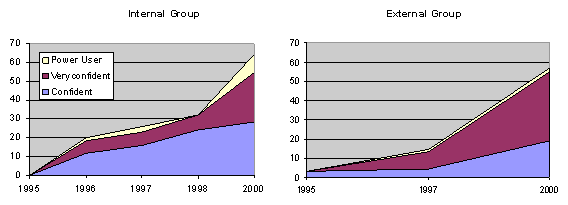
Figure 2. Internal group shows earlier development of confidence in web browsers
The curve had its steepest increase between 1995 and 1996, then plateaued out temporarily but increased again after 1998. The external student population also saw a steady increase between 1995 and 2000, although the linearity of that curve may be partially brought about by the fact that only three sampling points exist. The level in confidence observed for each year among the internal population increased significantly compared that of the previous year (ranges from P=0.05 to P<0.001). The same applies to the distance education body of the population (Spennemann & Atkinson 2002a).
As with many other applications assessed (Spennemann & Atkinson 2002a), more men than women claim to be confident in the use of the programs. This is more pronounced among the internal population (tables 5 and 6).
Table 5
Internal Student's Confidence when using World Wide Web Browsers.
Breakdown by Gender
| 1995 | 1996 | 1997 | 1998 | 2000 | |||||
| Fem | Male | Fem | Male | Fem | Male | Fem | Male | Fem | Male |
Not yet | 48.15 | 27.59 | 20.59 | 14.47 | 16.98 | 4.44 | 11.76 | 7.14 | — | 8.33 |
Near panic | — | — | 2.94 | 2.63 | 1.89 | — | — | — | — | — |
Very Uneasy | — | 3.45 | 2.94 | — | 3.77 | — | 2.94 | 7.14 | 3.45 | 4.17 |
A bit daunted | 14.81 | 3.45 | 8.82 | 13.16 | 11.32 | 15.56 | 14.71 | 7.14 | — | 4.17 |
Uncomfortable | 7.41 | 10.34 | 11.76 | 3.95 | 11.32 | 6.67 | 8.82 | 7.14 | 6.90 | 8.33 |
Comfortable | — | 6.90 | 19.12 | 31.58 | 33.96 | 17.78 | 29.41 | 25.00 | 13.79 | 8.33 |
Confident | — | — | 11.76 | 11.84 | 7.55 | 24.44 | 23.53 | 25.00 | 37.93 | 16.67 |
Very confident | — | — | 5.88 | 7.89 | 7.55 | 6.67 | 2.94 | 14.29 | 20.69 | 33.33 |
Power User | — | — | 1.47 | 1.32 | — | 6.67 | — | — | 6.90 | 12.50 |
no answer | 29.63 | 41.38 | 14.71 | 13.16 | 5.66 | 17.78 | 5.88 | 7.14 | 10.34 | 4.17 |
N | 27 | 29 | 68 | 76 | 52 | 44 | 34 | 28 | 29 | 24 |
Table 6
External student's confidence when using World Wide Web Browsers.
Breakdown by gender
| 1995 | 1997 | 2000 |
| |||
| Fem | Male | Fem | Male | Fem | Male | |
Not yet | 58.82 | 37.78 | 17.65 | 34.38 | — | 5.88 | |
Near panic | — | 2.22 | — | 3.13 | — | — | |
Very Uneasy | — | 2.22 | 8.82 | — | — | — | |
A bit daunted | — | 4.44 | 17.65 | 9.38 | 4.17 | 5.88 | |
Uncomfortable | — | 2.22 | 14.71 | — | — | — | |
Comfortable | — | 4.44 | 17.65 | 3.13 | 25.00 | 29.41 | |
Confident | — | 4.44 | 5.88 | 3.13 | 25.00 | 11.76 | |
Very confident | — | — | 5.88 | 9.38 | 33.33 | 41.18 | |
Power User | — | — | — | 3.13 | 4.17 | — | |
no answer | 29.41 | 37.78 | 11.76 | 34.38 | 8.33 | 5.88 | |
N | 17 | 44 | 33 | 31 | 23 | 17 | |
|
|
|
|
|
|
|
|
A regional break down of the internal students (table 7) shows that the confidence level of WWW use among rural students seems to marginally lag behind that of the metropolitan and non-metropolitan students. The same finding was indicated for e-mail usage (Spennemann & Atkinson 2002b).
The average responses between the Parks Management and the Information Technology Students (for the year 2000) were statistically very significantly different (P≤0.0001 !) (see table 4 for responses). The reason for this difference rests in the fact that many of the subjects IT students undertake are only available using a WWW browser. This requires IT students to be very proficient with using such applications.
Discussion
This longitudinal study has shown that the level of usage of WWW browser software applications has increased from 1995 to 2000 among all students outperforming more traditional applications such as word processing and spreadsheets (Spennemann and Atkinson 2002a). This conforms to the overall expectations and trend in the growth of the WWW (Haynal 2000). Jackson et al. (2001) showed that male students were more frequent and more confident users of WWW browsers than females, whereas the roles were reversed in the use of e-mail programs. Our longitudinal study supports this observation for the use of e-mail programs (Spennemann and Atkinson 2002a), as well as for the use of WWW browsers in the internal cohort investigated. Among the external students, however, the gender trend seems to be changing, as more mature-aged women make use of WWW browsers and increasingly gain confidence in their use.
An examination of the WWW browser as well as of other applications (word processing, spreadsheet etc) shows a correlation between the frequency of use and the level of confidence with which they are being used (Spennemann & Atkinson 2002a). A comparison of the environmental student population with that of the IT cohort shows that IT students are much more regular users of the WWW. This can be directly related to the requirement to use a WWW browser as the means of accessing the majority of teaching and learning materials. Likewise, the confidence in using the software is greater among IT students. This suggests that forced use of WWW browsers leads to more regular use of such browsers, which results in greater confidence among the users.
It can be posited that this in turn may increase the use of the applications for non-teaching/learning related aspects.
References
Atkinson, John S., Green, David G. & Spennemann, Dirk H.R. (1997). Delivering on-line education via the World Wide Web: the Charles Sturt University experience in: Michael Wyatt (ed.), Information on-line and on disk ‘97. Proceedings of the 8th Australasian Information Online and on Disc Conference (pp. 213-230). Sydney: Information Science Section, Australian Library and Information Association.
Atkinson, John and Spennemann, Dirk H.R (2002). Longitudinal study of male and female student attitudes to computing. ASCILITE in press
Brosnan, M. J. (1998). The impact of psychological gender, gender-related perceptions, significant others, and the introducer of technology upon computer anxiety in students. Journal of Educational Computing Research 18 (1), 63-78.
Clegg, S. (2001). Theorising the machine: gender, education and computing. Gender & Education. 13(3), 307-324.
Flowers, L., Pascarella, E. T., & Pierson, C. T. (2000). Information technology use and cognitive outcomes in the first year of college. Journal of Higher Education, 71(6), 637-667.
Haynal, R (2000). Internet Growth Charts [Online]. Available: http://navigators.com/stats.html [Accessed on 14 Aug 2002]
Honey M., Culp KM. and Carrigg F. (2000). Perspectives on technology and education research: Lessons from the past and present. Journal of Educational Computing Research. 23(1), 5-14.
Jackson LA. Ervin KS. Gardner PD. Schmitt N. (2001). Gender and the Internet: Women communicating and men searching. Sex Roles. 44(5-6), 363-379.
Lim, Kieran F and Kendle, Amanda (2001). IT skills of university first year undergraduate students: two 2001 matriculation cohorts. UniServe Scince News 18, October 2001. Available: http://science.uniserve.edu.au/newsletter/vol18/lim.html
Lim, Kieran F. and Lee, Jeanne (2000). IT Skills of university undergraduate students enrolled in a first year unit. Australian Journal of Educational Technology 16(3), 215-238.
Meredyth, D., Russell, N., Blackwood, L., Thomas, J. and Wise, P. (1999). Real Time: Computers, Change and Schooling. Canberra, Australia: Department of Education, Training and Youth Affairs.
Meredyth, D., Russell, N., Blackwood, L., Thomas, J. and Wise, P. (2000). Real time: Computers, change and schooling. Report for the Australian Bureau of Statistics. Brisbane, Australia: Griffith University.
Mitra, A., Lenzmeier, S., Steffensmeier, Avon, R, Qu, N and Hazen, M (2000). Gender and computer use in an academic institution: report from a longitudinal study. Journal of Education Computing Research. 23(1), 67-84.
Palmer, Stuart R. and Bray, Sharyn L. (2001). Longitudinal study of computer usage in flexible engineering education. Australian Journal of Educational Technology 17(3), 313-329.
Rogers, P. (2000). Barriers to adopting emerging technologies in education. Journal of Educational Computing Research. 22:4, 455-472.
Schott, G. and Selwyn, N. (2000). Examining the “male, antisocial” stereotype of high computer use. Journal of Educational Computing Research. 23(3), 291-303
Shuell, T. J. and Farber, S. L. (2001). Students perceptions of technology in college courses. Journal of Educational Computing Research. 24(2). 119-138.
Spennemann, Dirk H.R. (1995). Skimming the bright surface, or sounding the murky depths? Teaching to learn and learning to teach Cultural Resource Management face-to-face and at a distance. in J.Parker & R.J.Meyenn (eds.) Charles Sturt University Tertiary Teaching Colloquium Papers 1994. Charles Sturt University, Bathurst, NSW.
Spennemann, Dirk H.R. (1996a). Computers in Environmental Education. Assignment submission via electronic mail: problems & opportunities School of Environmental and Information Sciences Report Vol. 9. Charles Sturt University, School of Environmental and Information Sciences: Albury, NSW.
Spennemann, Dirk H.R. (1996b). Gender imbalances in computer access among environmental science students. Journal of Instructional Science and Technology Vol. 1(2). Available: http://www.usq.edu.au/electpub/e-jist/spenne.htm
Spennemann, Dirk H.R. (1997a). Do techno-sceptics use on-campus e-mail? Campus-Wide Information Systems 14(2), 46-53.
Spennemann, Dirk H.R. (1997c). Use of electronic mail among Park Management students at Charles Sturt University Wagga Wagga, NSW: Open Learning Institute,Charles Sturt University. Occasional Papers in Open and Distance Learning. Charles Sturt University 21, 29-40.
Spennemann, Dirk H.R. (1999). Welcome to the global classroom! Teaching in the 3rd millennium. Education at a Distance 13(1), 11-19.
Spennemann, Dirk H.R and Atkinson, John S. (2002a). Overcoming Technophobia? Computer use among Park Management students at Charles Sturt University: A longitudinal Study 1995-2000. Johnstone Centre Report Vol. 162. Albury, NSW: The Johnstone Centre, Charles Sturt University
Spennemann, Dirk H.R. and Atkinson, John S. (2002b). A longitudinal study of Data Management Practices among Parks Management Students. Campus-Wide Information Systems in press 2002.
Spennemann, Dirk H.R. and Atkinson, John S. (in press). A longitudinal study of the uptake of and confidence in using e-mail among parks management students. Campus-Wide Information Systems.
Spennemann, Dirk H.R., Birckhead, Jim, Green, David G. & Atkinson, John S. (1996). The electronic colonisation of the Pacific. Computer Mediated Communications Magazine Vol. 3(2). Available: http://www.december.com/cmc/mag/1996/feb/spen.html
Valentine G. & Holloway SL. (2001). A window on the wider world? Rural children's use of information and communication technologies. Journal of Rural Studies. 17(4), 383-394.
About the Author
Dirk HR Spennemann (MA Frankfurt, Ph.D. Australian National University) is Associate Professor in Cultural Heritage Management at Charles Sturt University, Albury, Australia. His main research interests are German colonial heritage in Oceania, in particular Micronesia, and historic preservation/ cultural heritage management issues in Micronesia. His second focus is threats to heritage posed by natural and human hazards and by managers in their efforts to counter these hazards. Ethical Heritage Planning and Policy are the cornerstones that need to be addressed if humanity's past is to have a meaningful future.
As a university educator, Dirk is interested in the implications of the utilization of information technology for students and staff. He serves on the editorial board of Campus-wide Information Systems. He is the author/editor of 22 books, with a life-time publication record of over 150 book chapters and refereed academic papers, over 60 non-refereed papers, and close to 100 technical reports and consultancy studies. He currently edits the Micronesian Journal for the Humanities and Social Sciences.
Tel: +61-2-6051 9947 Fax: +61-2-6051 9897
E-mail: dspennemann@csu.edu.au