Editor’s Note: For instructional designers and administrators, it is important to know which products and services are most used and most valued by students. This study provides definitive data for the School of Distance Education at University of Malaysia.
The Learners’ Support System in Distance Education: A Study of the Satisfaction of Quality
Helen Khoo Chooi Sim, Hanafi Atan and Rozhan M. Idrus
Abstract
This article reports on the study undertaken to determine the satisfaction of quality related to the 16 dimensions of the support system provided to the learners enrolled at the School of Distance Education (SDE), Universiti Sains Malaysia (USM). The three main aspects of this study were the frequency of usage, the degree of the usefulness in their learning and the critical dimension contributing towards the overall satisfaction of quality of the support system. The findings revealed that the learner support system consisting of the annual residential intensive course, modular printed learning materials, academic planner, the university library, the academic guide book and video conferencing were among the dimensions perceived to be useful by the students in providing the necessary support in the learning processes. The correlation analysis showed that all the 16 dimensions studied were significantly (p<0.01) and positively correlated with the overall satisfaction of quality. The modular printed materials recorded the highest positive correlation, followed by video conferencing, the annual residential course, regional centres and assignments. The Multinomial Logistic Regression analysis indicated that the modular printed learning materials emerged as a critical dimension for the overall satisfaction of quality with 77.9 percent predictability. The role of the modular printed materials towards the overall satisfaction of the quality of the support system is highlighted and discussed.
KeyWords: distance education, adult learner, support system, quality, learner satisfaction, academic support system, non-academic support system, learner’s needs, critical dimension of support system, video conferencing, printed module, regional center.
Introduction
Distance education has created enormous opportunities for the expansion of the educational opportunities especially at the higher educational level. This should be of great benefit to developed nations as well as developing countries in their human resource development and provision of a skilled labour workforce to drive the economic growth of their countries. Malaysia is a developing country with only about 16 percent of its population aged 20 and above possessing any form of post-secondary, college or university education (Malaysia, 2002). The Malaysian government hopes to raise this figure to 25 percent by the year 2020 by increasing access to higher education for its population (Gan, 2001). Distance education is thus becoming one of the important strategies that could be deployed to achieve this vision.
As the government strives to increase access to higher education, more and more distance education institutions are being established with various types of programmes being offered to cater to the increasing demand. With a growing number of distance education learners, the issue of quality becomes increasingly important. In this study, we focus on the quality of the support system that the institution provides to the learners and attempts to identify aspects of the learners’ support system that contribute most to the student’s learning process. This study subsequently tries to elucidate critical dimensions in the support system that contribute significantly to the overall quality of the support system. The results of this study are vital for the institution to identify the vital areas of the support system that should be given greater emphasis and improvement to ensure a high level of satisfaction among learners regarding the quality of the support system provided to them.
The Learners’ Support System in Distance Education
The learners’ support system in distance education may be defined as all activities beyond the production and the delivery of course materials that assist in the progress of students in their studies (Simpson, 2000). These can be in the form of facilities, administrative assistance, supplementary reading materials and references, human interaction, advice and moral support. Generally, it may be classified into two broad areas. The first is academic support which deals with supporting students with the cognitive, intellectual and knowledge issues of specific courses or sets of courses (Simpson, 2000). They include, for example, the development of learning skills, knowledge and literacy.
Besides the more traditional technologies such as print, broadcast television and radio, distance education providers add new technologies as they strive to enhance the quality of teaching and learning. These include use of audiotapes, videotapes, computer-based learning packages, interactive videos, interactive multimedia (IMM), audio-teleconferencing, audio-graphic communication systems, video conferencing, and videos on demand (VOD). The advancement of the information and communication technology (ICT) provides the opportunities for interactivity and access to instructional resources provided by computer communications networks popularly referred to as the Internet, the World Wide Web (WWW) or the Information Super Highway (Taylor, 1997).
The second category of the learners’ support system is non-academic – the support of students in the effective and organizational aspects of their studies (Simpson, 2000). Examples of the services contained within this support system are counselling services, orientation programme, course registration, news bulletin, and the student’s association. The learners’ support system is an important service that needs to be provided by the institution to the learners because of the characteristics of distance learners themselves. They are isolated and come from diverse backgrounds – economic, social, educational and occupational. The provision of such an educational support system ensures the facilitation of communication between students, the academic staff as well as the administrator to cater for administrative needs of the students (Kember & Dekkers, 1987; Sewart, 1992; Hillman et al., 1994).
The provision of learners’ support is now widely and increasingly recognized as an essential component of any open and distance learning system. As learners are the most important stakeholders in any educational system, distance education providers should provide the highest possible quality learner support services possible to all of them as without their presence, a distance education programme will not succeed (Ravisankar & Murthy, 2000).
As the responsibility of learning is in the hands of the learners, it is important that learners’ support from providers should also be learner-focused and meets the learners’ expectations and needs. Learners themselves are in the best position to know what kinds of support systems are pertinent in order to achieve their educational and personal goals. Moreover, distance education learners are adults and they are able to determine quality according to their individual needs (McIlroy & Walker, 1993).
Quality of the Learners’ Support System
Crosby (1979) defines quality as conformance to customer needs. Juran (1989) emphasized the importance of satisfying client needs. Quality is “fitness for use” which includes the identification of customer needs and attempt to meet these needs. This, when translated into educational terms, can be equated with the learner-centered approach (McIlroy & Walker, 1993). A key concept in current approaches to manage quality is putting the student first (Nunan & Calvert, 1991; Mills & Paul, 1993; Robinson, 1994) and designing procedures and courses which match the learners’ needs as closely as possible.
Quality in distance education has primarily been based on performance indicators of input and outcome measures and little attention has been paid to customer satisfaction as a measure of quality or through a “fitness for purpose/use” definition. The quality-satisfaction relationship is seldom examined explicitly. One reason for this is that both concepts are often used synonymously (Abrami, 1989; D'Apollonia & Cohen, 1990). In the quest of quality for the learners’ support system, attention should be paid to what quality means to the distance education learners. It is important that distance education providers should meet or exceed the expectation of their learners. Adult learners would demand quality in the products and services offered by the distance education providers and value for their money. Therefore, adult learners in the distance education systems are in the best position to assess the quality of the learners’ support that is provided.
Aims of Study and Methodology
The aims of this study are to identify 1) aspects of the learners’ support system that contributes significantly to the learning process of distance education learners, 2)frequency of use of these learner support services provided by the School of Distance Education (SDE), Universiti Sains Malaysia (USM), and 3) critical dimensions that contribute most to the overall quality of the learners’ support system.
The questionnaire developed for this study is the type that elicits the student’s expectation and perception regarding the sixteen dimensions of learners’ support currently provided by the SDE, USM. The dimensions were pre-registration, registration as a student, the academic planner, the academic guide book, the orientation programme, printed learning materials, supplementary materials (multimedia), video conferencing, counselling services, the intensive course, regional centres, the student’s bulletin, the main library, the students’ association, assignments and examination. The questionnaire consisted of 171 items and each item was accompanied by two five-point Likert scales one for the expectation of quality and the other for the perception of quality. A pilot test was conducted prior to the actual study to test the reliability of the questionnaire. The overall Cronbach’s Alpha coefficient of 0.9839 was recorded for the expectation of quality and 0.9755 for the perception of quality. The coefficient indicated that the questionnaire was reliable. The measurement of quality was based on the Expectancy Disconfirmation Theory which proposed that if the mean of perception exceeds the mean of expectation (a positive disconfirmation), a student is very satisfied with the quality. If the mean of perception equals the mean of expectation (zero disconfirmation), a student is only satisfied with the quality. However, the student is not satisfied about the quality if the mean of perception falls short of her or his expectation (negative disconfirmation).
The sample for this study was students of SDE, USM, from the academic session 2002/2003. The questionnaires were distributed randomly to 558 students during the three-week annual residential intensive course held at the main campus of USM. The questionnaires were distributed in person by the researcher and completed questionnaires were collected at a specific time agreed to by both parties. Data analysis was conducted using the SPSS version 10.0.
Results and Discussion
Frequency of Use
Table 1 shows the frequency of use of the learners’ support system provided by SDE, USM. As can be seen, the most frequently used learners’ support system is the intensive course held annually at the main campus (mean=4.15). The high mean recorded is expected as the annual residential course is made compulsory among learners and failure to attend without valid and acceptable reasons will result in the students being barred from sitting the final examination. The next highest recorded frequency is the printed learning materials (mean=4.10). The printed learning materials are the specially designed self-instructional learning materials which are the main source of learning materials. Again, this high frequency recorded is expected as the printed learning materials form the main mode of the course delivery mechanism and is being used regularly by the students to keep pace with their study schedule. The next highest support system that is being used by the students is the academic planner (mean=3.88). The academic planner is the academic self-organizer which highlights the important academic activities throughout the academic session. This planner enables the students to systematically organize their study schedule and it thus is of great assistance to the learners. The use of library facilities also recorded a high mean (mean=3.78), followed closely by video conferencing (mean=3.65) and the academic guide book (mean=3.53).
Table 1
Frequency of use of the learners’ support system
| Very Seldom (%) | Seldom (%) | Neither Often nor Seldom (%) | Often (%) | Very Often (%) | Mean (SD) n=340 |
1. Academic Planner | 4 | 36 | 26 | 205 | 69 | 3.88 (0.89) |
2. Academic Guide Book | 6 | 64 | 49 | 187 | 34 | 3.53 |
3. Printed Learning Materials | 2 | 13 | 29 | 20 | 96 | 4.10 |
5. Video Conferencing | 28 | 30 | 48 | 162 | 72 | 3.65 |
6. Counselling Services | 88 | 88 | 90 | 60 | 14 | 2.48 |
7. Intensive Course | 7 | 20 | 16 | 168 | 129 | 4.15 |
8. Regional Centres | 28 | 49 | 60 | 162 | 41 | 3.41 |
9. Students’ Bulletin | 45 | 83 | 90 | 106 | 16 | 2.90 |
10. Main Library | 10 | 35 | 33 | 204 | 58 | 3.78 |
11. Students’ Association | 126 | 83 | 75 | 52 | 4 | 2.19 |
Degree of Usefulness
Table 2 shows the results on the degree of usefulness of various dimensions of the learners’ support system towards their learning process. The dimensions that recorded the highest mean and perceived to be useful in helping the respondents in their studies were the intensive course (mean=4.42) followed by the printed learning materials (mean=4.34), the academic planner (mean=4.20), the main library (mean= 4.16), the academic guide book (mean=4.09) and video conferencing (mean=3.98). As expected, the dimensions that recorded the highest means were those that supported the students with cognitive, intellectual and knowledge through the mediation and facilitation of the standard and uniform elements of course materials and learning resources. The annual intensive course (a three-week on-campus residential school) was perceived to be the most useful in assisting them in their learning process relative to other dimensions. The intensive course consists mainly of face-to-face tutorial sessions with lecturers for course content facilitation. The tutorial services have been known to have positive effects on the students’ learning outcomes (Morgan & Morris, 1994; Stevenson & Sander, 1998). Similarly, the facilitation by the lecturer and the student-peer collaboration during the video conferencing sessions which helped students to clarify issues pertaining to the course contents were found to improve and enhance students’ understanding (Knox, 1997; Daud et al., 2000).
Table 2
The Degree of Usefulness of the Learners’ Support System
| Not Very Helpful (%) | Not Helpful(%) | Uncertain (%) | Helpful (%) | Very Helpful (%) | Mean (SD) n=340 |
1. Academic Planner | 1 | 5 | 22 | 209 | 103 | 4.20 |
2. Academic Guide Book | - | 12 | 34 | 205 | 89 | 4.09 |
3. Printed Learning Materials | - | 2 | 24 | 170 | 144 | 4.34 |
7 | 32 | 122 | 133 | 46 | 3.53 | |
5. Video Conferencing | 14 | 10 | 47 | 169 | 100 | 3.98 |
6. Counselling | 33 | 55 | 142 | 87 | 23 | 3.04 |
7. Intensive Course | - | 2 | 19 | 153 | 166 | 4.42 |
8. Regional Centres | 15 | 30 | 79 | 166 | 50 | 3.61 |
9. Students’ Bulletin | 27 | 60 | 113 | 118 | 22 | 3.14 |
10. Main Library USM | 3 | 15 | 25 | 180 | 117 | 4.16 |
11. Students’ Association | 89 | 82 | 100 | 57 | 12 | 2.47 |
Critical Dimensions
Before undertaking an analysis to elucidate the critical dimensions contributing to the overall satisfaction of quality, the frequency analysis of the degree of satisfaction was carried out. Based on the Expectancy Disconfirmation Theory, three different satisfaction groups were established, namely the very satisfied, satisfied and not satisfied. The analysis revealed that 59.7 percent of the respondents were very satisfied, 7.9 percent satisfied and 32.4 percent not satisfied. The distribution of the means of these three groups in relation to the sixteen dimensions is depicted in Figure 1. As expected, the group that was very satisfied recorded the highest means compared to the other two groups across each of the dimensions. The profile distribution of the means for each group is parallel indicating that the relative perception of each group in terms of the given dimensions is similar, the difference being only on the level of satisfaction of quality.
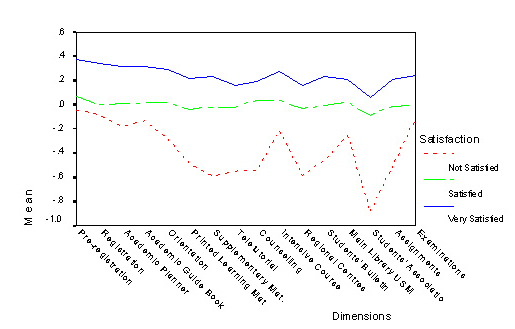
Figure 1. Means distribution across sixteen dimensions of
the support system for three different satisfaction levels.
A correlation analysis was conducted to determine the extent of correlation of each of the dimensions towards the satisfaction of quality. The result of the correlation analysis is depicted in Table 3. As shown in Table 3, printed learning materials (0.850) recorded the highest positive correlation with satisfaction of quality. It was followed by video conferencing (0.835), the intensive course (0.811), regional centres (0.809) and assignments (0.808). The results indicated that printed learning materials are an important factor in determining the overall quality of the learners’ support system.
Table 3
Correlation of dimensions of the learners’ support system
with overall satisfaction of quality
Dimension of the | Correlation with the |
1. Pre-registration | 0.463* |
2. Registration as a Student | 0.561* |
3. Academic Planner | 0.670* |
4. Academic Guide Book | 0.672* |
5 Orientation Programme | 0.740* |
6 Printed Learning Materials | 0.850* |
7. Supplementary Materials (Multimedia) | 0.789* |
8. Video Conferencing | 0.835* |
9. Counselling | 0.762* |
10. Intensive Course | 0.811* |
11. Regional Centres | 0.809* |
12. Students’ Bulletin | 0.792* |
13. Main Library | 0.736* |
14. Students’ Association | 0.699* |
15. Assignments | 0.808* |
16. Examinations | 0.631* |
*Significant at p<0.01
To determine the degree of the contribution of the three highest positively correlated dimensions towards the overall satisfaction of quality, namely, the printed learning materials, video conferencing and the intensive course, a Multinomial Logistic Regression was conducted towards the three different groups of satisfaction i.e., the very satisfied, satisfied and not satisfied groups. Table 4 (i) shows the results for the printed learning materials. The results revealed the contribution of the printed learning materials towards the overall quality was significant. Nagelkerke Pseudo R-Square (Table 4 (ii)) recorded a value of 0.522 and the Likelihood Ratio Test (Table 4 (iii)) indicated that the variable printed learning materials are significant and should be included in the model for the overall quality of satisfaction. The overall predictability (Table 4 (v)) was 77.9 percent and this implied that the printed learning material is a good predictor for learners in the very satisfied group (96.6% correct).
When the dimension of video conferencing, which recorded the second highest correlation with the overall satisfaction of quality, was modelled together with printed learning materials, the model was also significant. The Nagelkerke Pseudo R-Square now recorded a value of 0.590 and the Likelihood Ratio Test indicated that the variable printed learning materials and video conferencing were both significant and should be in the model for the overall satisfaction of quality. The overall predictability now increased to 80.9 percent, an increase of 3.0 percent. However, predictability of those in the very satisfied group now decreased by 0.5 percent to 96.1 percent. The predictability of those in the not satisfied group increased from 62.7 to 72.7 percent.
Table 4 (i)
Model fitting information
Model | -2 Log Likelihood | Chi-Square | df | Sig. |
Intercept Only | 313.509 |
|
|
|
Final | 121.523 | 191.986 | 2 | 0.000 |
Table 4 (ii)
Psuedo R-Square
Cox and Snell | 0.431 |
Nagelkerke | 0.522 |
McFadden | 0.323 |
Table 4 (iii)
Likelihood Ratio Tests
Effect | -2 Log Likelihood of Reduced Model | Chi-Square | df | Sig. |
Intercept | 211.571 | 90.048 | 2 | 0.000 |
Printed Learning Materials | 313.509 | 191.986 | 2 | 0.000 |
Table 4 (iv)
Parameter Estimates of Multinomial Logistic Regression
Satisfaction of quality |
|
B |
Std. Error |
Wald |
df |
Sig. |
Exp(B) | 95% Confidence Interval for Exp(B) | |
Lower Bound | Upper Bound | ||||||||
Not Satisfied | Intercept | -0.956 | 0.167 | 32.606 | 1 | 0.000 |
|
|
|
| PLM | -7.079 | 0.936 | 57.150 | 1 | 0.000 | 8.430E-04 | 1.345E-04 | 5.282E-03 |
Satisfied | Intercept | -1.722 | 0.215 | 64.053 | 1 | 0.000 |
|
|
|
| PLM | -3.929 | 1.008 | 15.199 | 1 | 0.000 | 1.966E-02 | 2.728E-03 | 0.142 |
Table 4 (v)
Classification
Predicted | ||||
Observed | Not Satisfied | Satisfied | Very Satisfied | % |
Not Satisfied | 69 | 0 | 41 | 62.7% |
Satisfied | 3 | 0 | 24 | 0.0% |
Very Satisfied | 7 | 0 | 196 | 96.6% |
Overall Percentage | 23.2% | 0% | 76.8% | 77.9% |
The analysis of the contribution of the intensive course that recorded the third highest correlation coupled together with the printed learning materials and video conferencing to the overall quality was conducted. When the dimension of the intensive course was modelled together with printed learning materials and video conferencing, the model was also found to be significant. The Nagelkerke Pseudo R-Square then increased and recorded a value of 0.604. The Likelihood Ratio Test indicated that the three variables of the printed learning materials, video conferencing and intensive course were all significant and should be in the model for the overall satisfaction of quality. However, the overall predictability now remained at 80.9 percent. The predictability of those in the “very satisfied” and “not satisfied” groups remained at 96.1 percent and 72.7 percent respectively.
This study indicated that the printed learning material dimension recorded the highest positive correlation towards the overall satisfaction of quality with the highest contribution towards the usefulness to the learners in terms of their learning process (mean=4.34). This dimension was also one of the dimensions that was often used by the learners (mean=4.10). The Multinomial Logistic Regression conducted indicated that the dimension printed learning materials was a good indicator for the overall satisfaction of quality especially by the very satisfied group.
This finding implies that the printed learning materials is the most important dimension and imperative in the determination of the satisfaction of quality of the learners’ support system. In order to increase the satisfaction of learners towards the learners’ support system, it is therefore vital for the SDE, USM to increase the satisfaction of learners in the dimension of the printed learning materials. As noted by Mann (1998), the modular printed learning materials are the concrete frontier of quality assurance. This finding is also consistent with the study of Ibrahim & Silong (1997) which pointed out that the academic module (printed learning materials) is an important aspect in the learners’ support system. McIIroy (1997) also revealed that the printed course materials are extremely effective in enhancing the quality of the courses offered. Printed learning materials is the main source of learning as far as the open and distance learners are concerned because of their characteristics of being self-instructional, self-explanatory, self-contained, self-directed, self-evaluated, self-learning and self-motivating (Partovi, 1997). To achieve the highest standards of quality in the provision of services for the learners’ support system, it is therefore imperative that the printed learning materials are suitably designed with the intended characteristics to fulfil the learning objectives and be constantly reviewed to keep up to date with current issues and the latest knowledge of the course contents.
Summary
This study revealed that the printed learning materials is the most important dimension in the learners’ support system and contributed the most to the overall satisfaction of quality. The quest towards quality in the learners’ support system provided to the student should be viewed as a never-ending process. Determining the critical dimensions that contribute to the satisfaction of quality of support is imperative to enhance the quality of the distance education offered to students. This study provides an insight for the distance education providers to focus on the support system that contributes positively to the learners’ overall satisfaction of the quality. Appropriate steps should continuously be taken to maintain the highest level of satisfaction of quality among the learners in order to remain and to excel in an increasingly competitive industry.
References
Abrami, P. C. (1989). How should we use student ratings to evaluate teaching? Research in Higher Education, 30(2), 221-27.
Crosby, P. B. (1979). Quality is Free. New York: McGraw-Hill.
Daud, S.M., Hashim, Y., & Saleh, M.N. (2000). Factors influencing the effectiveness of teaching and learning through the video conferencing in distance education (in Malay). Malaysian Journal of Distance Education, 2(1), 67-90.
D'Apollonia, S. & Cohen, P. (1990). Validity of student ratings of instruction: what we know and what we do not? Journal of Educational Psychology, 82, 219-231.
Gan, Siowck-Lee. (2001). Malaysia. In O. Jegede & G. Shive (Eds.), Open and Distance Education in Asia Pacific Region. Hong Kong: Open University of Hong Kong Press.
Hillman, D. C. A., Willis, D. J. & Gunawardena, C. N. (1994). Learner-interface interaction in distance education: an extension of contemporary models and strategies for practitioners. American Journal of Distance Education, 8(2), 30-34.
Ibrahim, D. Z. & Silong, A. D. (1997). Assuring quality learning support for teachers’ distance education program. In P.C. Chew, (Ed.). Quality Assurance in Distance and Open Learning. Conference Proceedings, Vol. 2. 11th Annual Conference and Exhibition. Asian Association of Open Universities, 11-14 November, Kuala Lumpur, Malaysia.
Juran, J.M. (1989). Juran on Leadership for Quality: An Executive Handbook. New York: The Free Press.
Kember, D. & Dekkers, J. (1987). The role of study centres for academic support in distance education. Distance Education, 8(2), 30-42.
Knox, D.M. (1997). A review of the use of video conferencing for actuarial education – a three-year case study. Distance Education, 18(2), 225-235.
Malaysia. (2002). Laporan Ciri-Ciri Pendidikan Dan Sosial Penduduk, Banci Penduduk Dan Perumahan 2000. Retrieved 20.8.2002 from http://www.statistics.gov.my/Bahasa/presspendidikan.htm
Mann, C. C. (1998). Quality assurance in distance education: the Surrey MA (TESOL) experience. Distance Education, 19(1), 7-22.
McIlroy, A. & Walker, R. (1993). Total quality management: some implications for the management of distance education. Distance Education, 14(1), 40-54.
McIlroy, A. (1997). Quality in business education: perceptions of staff and students in an undergraduate program. In P.C. Chew, (Ed.). Quality Assurance in Distance and Open Learning. Conference Proceedings, Vol. 1. 11th Annual Conference and Exhibition. Asian Association of Open Universities, 11-14 November, Kuala Lumpur, Malaysia.
Mills, R. & Paul, R. (1993). Putting the student first: management for quality in distance education. In T. Evans, & D. Nation (Eds.). Reforming Open and Distance Education Critical Reflections form Pacific. London: Kogan Page.
Morgan, C., & Morris, G. (1994). The student view of tutorial support: report of a survey of Open University Education students. Open Learning, 9(1), 22-33.
Nunan, T. & Calvert, J. (1991). Investigating quality and standards in distance education - an interpretation of issues. Paper presented at the 10th Biennial Forum, Australian and South Pacific External Studies Association, NSW, Australia, 15-19 July, 1991.
Partovi, T. (1997). Revolution in learner-centered education in the 21st century. In P.C. Chew, (Ed.). Quality Assurance in Distance and Open Learning. Conference Proceedings, Vol. 1. 11th Annual Conference and Exhibition. Asian Association of Open Universities, 11-14 November, Kuala Lumpur, Malaysia.
Ravisankar, K & Murthy, C. R. K. (2000). Student participation circles: an approach to learner participation in quality improvement. Indian Journal of Open Learning, 9(1), 73-85.
Robinson, B. (1994). Ensuring quality in the planning and development of distance learning courses. Paper presented at the 20th Anniversary International Conference on Distance Learning, Colombia, September 20-22.
Sewart, D. (1992). Student support systems in distance education. Paper presented at the 16th Conference of the International Council for Distance Education, Thailand, 8 - 13 November, 1992.
Simpson, O. (2000). Supporting Students in Open and Distance Learning. London: Kogan Page.
Stevenson, K., & Sander, P. (1998). How do Open University students expect to be taught at tutorials? Open Learning, 13(2), 42-46.
Taylor, J. C. (1997). Flexible learning systems: opportunities and strategies for staff development in industry. In P. C. Chew (Ed.). Quality Assurance in Distance and Open Learning. Conference Proceedings, Vol. 1. 11th Annual Conference and Exhibition. Asian Association of Open Universities, 11-14 November, Kuala Lumpur, Malaysia.
About the Authors
Helen Khoo Chooi Sim, Hanafi Atan & Rozhan M. Idrus
School of Distance Education
Universiti Sains Malaysia
11800 Pulau Pinang
Malaysia